




Activity: In Plain Sight

Activity
In Plain Sight
This “find the object” teambuilding activity uses clues to build observation skills as participants locate a specific item in a designated area.
Prepare the Space
- Define the area: Choose a room or outdoor space. Create boundaries using a rope, tape, or cones.
- Place several items in the area before the group views it.
- Identify one object you’ll ask the group to locate. It doesn’t have to be fancy! Anything — a clothespin, pen, or piece of wood — can work well. Do not tell them what you selected.
- Ask students to quickly view the area and then tell them to close or cover their eyes and turn around, so everyone is facing away from the area. From this point on, no speaking is allowed in the game.
Let’s Play!
Round 1
- Tell the students you are going to hide the object they need to locate in plain sight, within 10 to 15 feet of where the group is standing. Place the object anywhere you like — on the ground, hanging from a tree branch, next to a tree, or clipped on a person’s clothing — but just make sure it’s in a very visible location.
- Have students open their eyes, turn back toward the area, and step into it to search for the object.
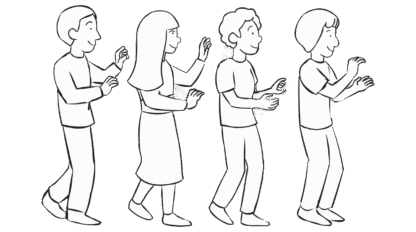
- Once they locate the object, they should cover their mouth, step outside the area, and remain frozen outside the area until everyone has found the object. They should not point or tell others where it is.
- Once everyone has located the object and stepped outside the area, you can repeat the process with a few more rounds.
Rounds 2 and 3
- Repeat this process for at least two more rounds, increasing the difficulty each time.
- For the last round, you can tell participants they cannot move once they see the object, instead planting their feet in whatever position they’re in when they find it. This allows them to help others without sharing where the object is hidden.
- Attaching an object like a clothespin to the back of someone’s sweatshirt hood and giving false tugs to the hoods of other people in the group can be a fun distraction. Pant legs and shoelaces are also great places to hide something like a clothespin.
The Rationale
- Placing a hand over the mouth is a visual clue as to where the pin is, and it requires kids to be more observant and curious than verbal cues like gasps or simply saying, “I found it!”
- Freezing in place can also be a clue to the direction of the pin or that the pin is moving if participants use deductive reasoning.
Debrief the Activity
After the activity, discuss what worked well, what challenges the team encountered, and how the team contributed to success. This activity fosters problem-solving skills, teambuilding, and creativity. You can easily re-frame this debrief to discuss integrity, bullying, social norms, body language/cues, inclusivity, and how rifts between “those in the know” and “those on the outside” can easily escalate.
Here are questions to help guide the conversation:
- How did it feel to know where the object was when other people had not found it?
- How did it feel to know that someone knew where it was before you were able to find it?
- Why do we think exclusive behavior happens in our day-to-day lives? Is it fun to be “in the know?”
- Do we try to keep others “on the outside?” How? Why?
- How does laughing at a situation feel to the people laughing? How does it feel to people who aren’t laughing? Did this behavior escalate the situation?
- How did you know when someone found the object?
- Did anyone give cues to help you? If so, why? If not, why not?
Subscribe for Resources
If you liked this post, sign up to receive more activities, games, initiatives, and other teaching and facilitation resources. You’ll get our seasonal e-newsletter for educators, the Teambuilding & Experiential Learning Quarterly, as well as Hale’s monthly eNews.
Learn More! Sign up for Emails